KRIDEM – Circular economy in the trade fair industry
OTWorld 2026 becomes a model
Photo: Niclas Schmidt
Photo: Niclas Schmidt
When OTWorld celebrates its 50th anniversary in early summer 2026, it will be more than just the world's largest platform for modern medical aids: The trade fair also serves as a real-world laboratory for the research project "KRIDEM – Circular Economy in the Trade Fair Industry" and thus as a test setup for visualising the material, energy, water and waste flows of an entire trade fair ecosystem.
KRIDEM is the first project to analyse the trade fair industry through the lens of the circular economy. The initiative focuses on recording material flows, identifying return channels, examining organisational structures, and developing practical strategies for circular trade fair practices. Supported by approximately €150,000 in funding from the German Federal Environmental Foundation (DBU), KRIDEM is set to run until the end of 2026 under the scientific leadership of Osnabrück University of Applied Sciences. Project partners include the CSR agency 2bdifferent, exhibition architects imb troschke, and the Association of the German Trade Fair Industry (AUMA). The ultimate goal is to establish measurable foundations for future trade fair planning and implementation—ensuring resource conservation, closing material loops, and reducing climate impact.
Advertisement
A research project for the entire industry
The trade fair industry is experiencing profound transformation: rising energy prices, material shortages, increasing innovation pressure, and the urgent need to reduce CO₂ emissions. At the same time, exhibiting companies are developing a more nuanced understanding of sustainability. While many trade fair companies, organisers, service providers, and stand builders have already implemented individual solutions, there is still a lack of an integrated perspective on the overall "trade fair" ecosystem. After all, a trade fair company is much more than just a hall operator or event organiser—it is also an energy consumer, logistics hub, catering provider, landlord, client of waste management firms, and a key element of the urban infrastructure. This is precisely where the KRIDEM project comes in.
KRIDEM at BOE International
On 14 January 2025, the research project "KRIDEM – Circular Economy in the Trade Fair Industry" will be presented at the BOE International in Dortmund. Following a keynote speech by Prof. Dr. Kim Werner on the nexus approach as a way of optimising resource models, other research partners will have their say in the subsequent talk. Participants include: Dr Christoph Soukup (2bdifferent), Michel Ghattas-Kämpfner (Leipziger Messe), Barbara-Maria Lüder (AUMA), Justine Hein (tw tagungswirtschaft / m+a report) and Jürgen May (2bdifferent).
- Vision Stage | Hall 4 | 4.F30 | 12:15 to 13:00
The research project approaches material, energy, water, and waste flows not as isolated elements, but in terms of their interactions. It investigates how processes, decisions, and partnerships impact resource efficiency—and where untapped optimisation potential still exists. To fully understand these dynamics, the project team requires more than just theoretical models: they need direct access to the real-world processes, data, and challenges of an exhibition centre. For this purpose, Leipzig Trade Fair is opening its doors. For them, the project represents more than just an opportunity for internal optimisation. “We consider ourselves a driving force for a circular trade fair industry,” says Michel Ghattas-Kämpfner, Sustainability Manager at Leipzig Trade Fair.
Advertisement
© Estrel Berlin / Johannes Berger
Trade fair operations under the microscope
“With KRIDEM, our goal is not just to fine-tune individual parameters—we want to examine our entire infrastructure, our services, and our partner network through the lens of circularity.” Achieving true circularity, however, requires partners who are willing to evaluate all relevant interfaces together. For this purpose, Leipziger Messe is offering one of its largest events, OTWorld 2026, as a real-world laboratory. The decision to choose OTWorld is well-founded both scientifically and operationally: as the world’s leading event for orthopaedic technology, rehabilitation technology, and orthopaedic footwear technology, OTWorld is a highly professional industry platform with significant international reach.
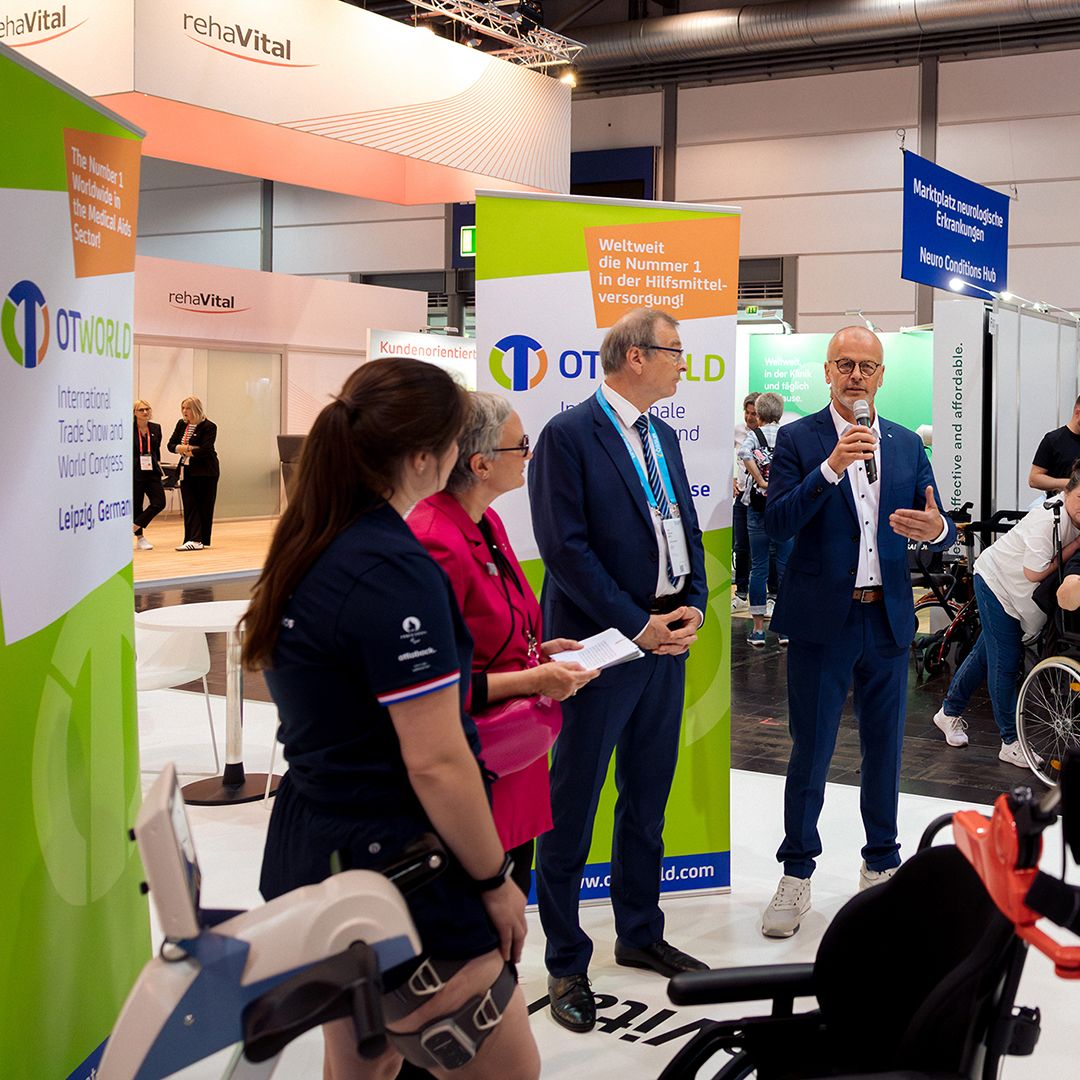
The integrated OTWorld World Congress covers a wide range of topics. These range from prosthetics, orthotics and orthopaedic shoe technology to sports orthopaedics and parasports to age-appropriate assistance systems and digitalisation. Integrative care, rehabilitation and training will be the core topics at OTWorld 2026. Photo: Uwe Frauendorf
With more than 20,000 visitors from over 90 countries and over 550 exhibitors, OTWorld features an extensive world congress and brings together the full spectrum of industry, trade, research, and healthcare—encompassing nearly all structures relevant for material flow analysis. Additionally, OTWorld has a high density of system stand construction, which enables consistent and comparable analysis: the components are modular, materials are standardized and repetitive, and transport as well as storage logistics are well established. For the Circular Scan—the core of the research project—this environment allows for more accurate comparison of material flows, more reliable derivation of quantities, and more precise assessment of changes.
Der Circular Scan
In the KRIDEM project, a Circular Scan is used to explore the trade fair industry on two complementary levels: material flows and organisational anchoring. “The trade fair industry is a complex system made up of countless supply chains and stakeholders. Only by precisely identifying where resources are consumed, wasted, or reused can we develop targeted circular strategies,” explains Jürgen May, Managing Director of 2bdifferent. In collaboration with the exhibition architecture firm imb troschke, the sustainability consultancy is overseeing the first phase of material flow mapping at OTWorld 2026. Key questions include: How much material, energy, water, and waste are generated? What paths do these resources follow, and where is there untapped potential for recycling or savings? The data collected will provide the foundation to define measurable action areas and to develop strategies for reducing and reusing resources.
As part of the Circular Scan, the project team is analysing not only the material flows but also the organisational structures within the Leipziger Messe Group. They are investigating to what extent circular principles are already embedded in strategic and operational processes, decision-making procedures, and corporate culture. By combining material flow analysis with organisational review, the project aims to deliver a practical and comprehensive picture—one that not only assesses resource efficiency but also reflects the internal conditions and processes that shape interactions among all involved stakeholders.
“OTWorld is a powerful platform for innovation—both technologically and structurally,” emphasises Antje Voigtmann, Project Director of OTWorld. “We are proud to be part of KRIDEM. For us, this project offers the chance to view the trade fair industry from an entirely new angle. Together with our partners, we want to understand which levers we can use to conserve resources and establish sustainable structures—and how this will also create advantages for our exhibitors in positioning themselves for the future,” Voigtmann continues. These levers can be found throughout the entire exhibition site: in the halls, basements and technical rooms, at waste disposal stations, in kitchens, storage areas, logistics, and stand construction."
How processes interlock
What sets KRIDEM apart is its ambition not just to “collect data” in these areas, but also to uncover underlying structures and interrelationships. Understanding how key players interact is crucial, as countless processes in the trade fair industry are interconnected: hall technology affects energy consumption; stand construction impacts transport volumes; catering influences water use and waste streams; logistics shape material movements; and organisational routines determine the quality of waste separation and overheads. By mapping these stakeholder interactions, KRIDEM reveals where cooperation can develop and highlights areas where resources have previously been lost.
Thinking about resources together
In addition to the Circular Scan, another unique aspect of the KRIDEM project is its use of the Nexus approach. “While the circular economy focuses on avoiding waste through the reduction, reuse, recycling, and recovery of materials, the Nexus approach takes it a step further. It aims to leverage the interdependencies between different resources to minimise waste and inefficiency through cross-sector solutions and process optimisation,” explains Prof. Dr. Kai-Michael Griese from Osnabrück University of Applied Sciences.
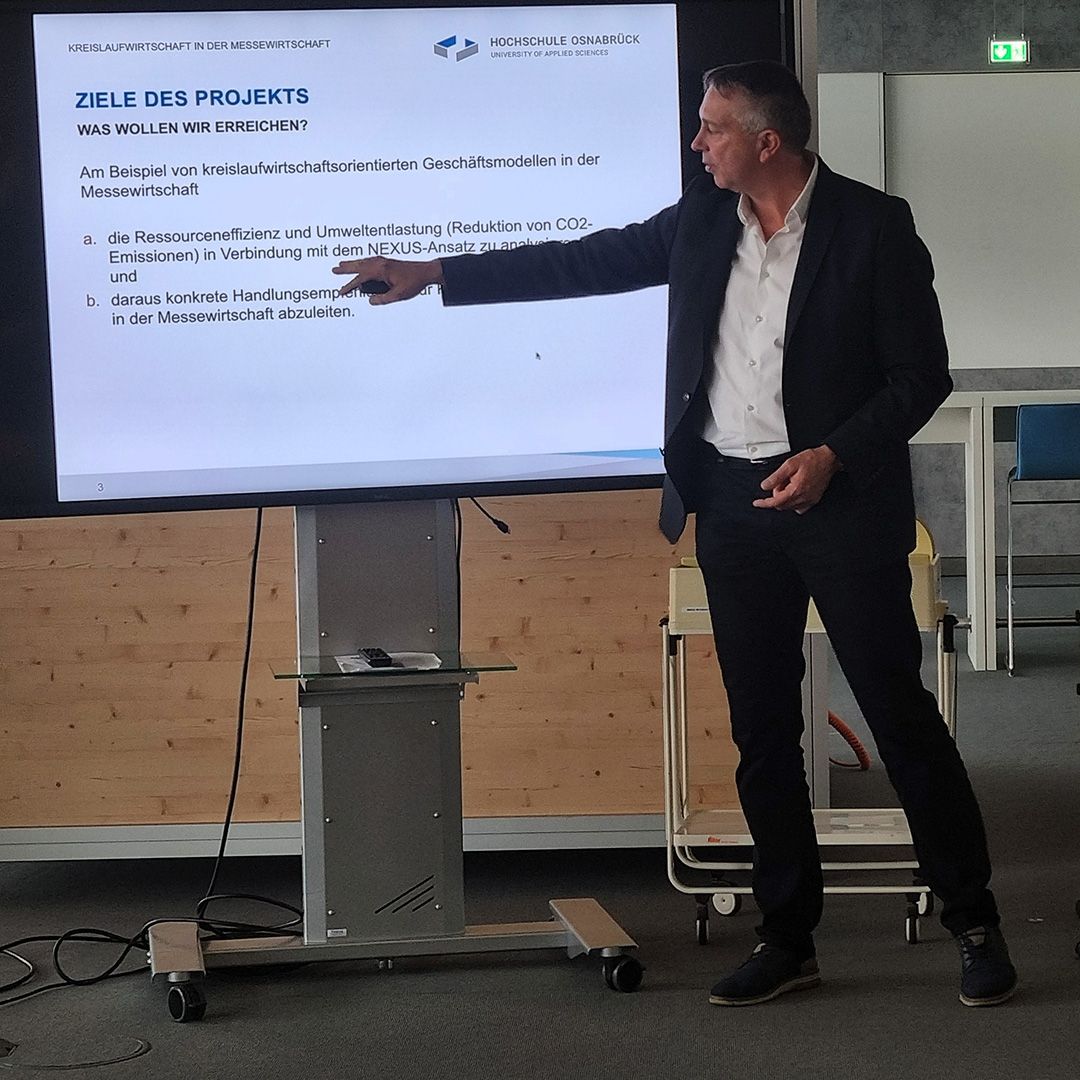
In the KRIDEM project, the term "nexus" refers specifically to the interconnections between material, energy, water, and waste flows. In practice, this means that any change in one of these areas impacts the others—potentially creating new synergies, but also possible conflicts. For example, if stand construction shifts to reusable materials, this not only alters the amount of waste generated, but also affects transport volumes, energy demands, and logistics structures. The trade fair industry is characterised by temporary infrastructures, a wide range of service flows, and short usage cycles—an environment in which sustainability can only be achieved by considering all these systems together.
“Ultimately, it reveals where energy, materials, water, and waste flows interact—and where cycles can be closed or remain open,” says Prof. Dr. Kim Werner, who leads the KRIDEM project together with Prof. Dr. Kai-Michael Griese at Osnabrück University of Applied Sciences. “Our aim is to develop actionable, transferable recommendations and business models that will strengthen the long-term resilience of trade fair companies and their partners.” To achieve this, the project team combines quantitative and qualitative methods: they analyse material flows and also examine the organisational framework. Key questions include: What decisions are made, and at what points in the process? What requirements exist? How is coordination managed between the trade fair organisers, exhibitors, service providers, the city, and the region?
And, crucially: where do established processes cause resources to be “lost”? This was the precise reason why the KRIDEM project team met at Leipziger Messe at the end of October 2025. Before models can be developed and scenarios simulated, the team needs a holistic view of OTWorld’s “engine room.” The on-site visit was used to check data availability, better understand operational realities, and, together with Leipziger Messe departments, determine which material flows can be captured accurately and where only estimates are currently possible. Key focus areas included the hall infrastructure, energy management, event technology, waste logistics, fairgourmet catering, FAIRNET stand construction, and Leipzig Tourism and Marketing as the destination partner."
Sustainability check: Where Leipzig Trade Fair stands today
Leipzig Trade Fair already has a number of well-established sustainability measures in place on which the KRIDEM project can build. Since 2023, the company has been sourcing 100 per cent of the electricity for its home site from green energy; in addition, a photovoltaic system has been installed that covers around 15 per cent of its own requirements. Waste processes are geared towards consistent separation and are supported by modern waste compactors, four-chamber containers and digitised processes. In the catering sector, the catering subsidiary fairgourmet has been using certified organic, fair trade coffee, regional food, reusable tableware and deposit systems for years – which was confirmed in 2024 with GreenSign Gastro certification. The trade fair company has been awarded the Green Globe seal since 2009 and, by signing the Net-Zero-Carbon-Events-Pledge, has set itself the goal of becoming CO2-neutral by 2040.
These discussions have made it clear that Leipziger Messe is not starting from scratch, even though KRIDEM has yet to bring full transparency to the entire resource system. The company already has access to extensive data, but it also recognises specific areas for improvement—such as cooling consumption, water use detail, and recycling rates. At the same time, it became apparent that operational realities must be integral to the analysis. Time-critical dismantling phases, concurrent catering events, individual exhibitors’ budget constraints, and established organisational routines cannot simply be “modelled away.” In the trade fair context, a circular economy only becomes feasible if it takes these real-world conditions into account and develops solutions that support—rather than hinder—day-to-day operations.
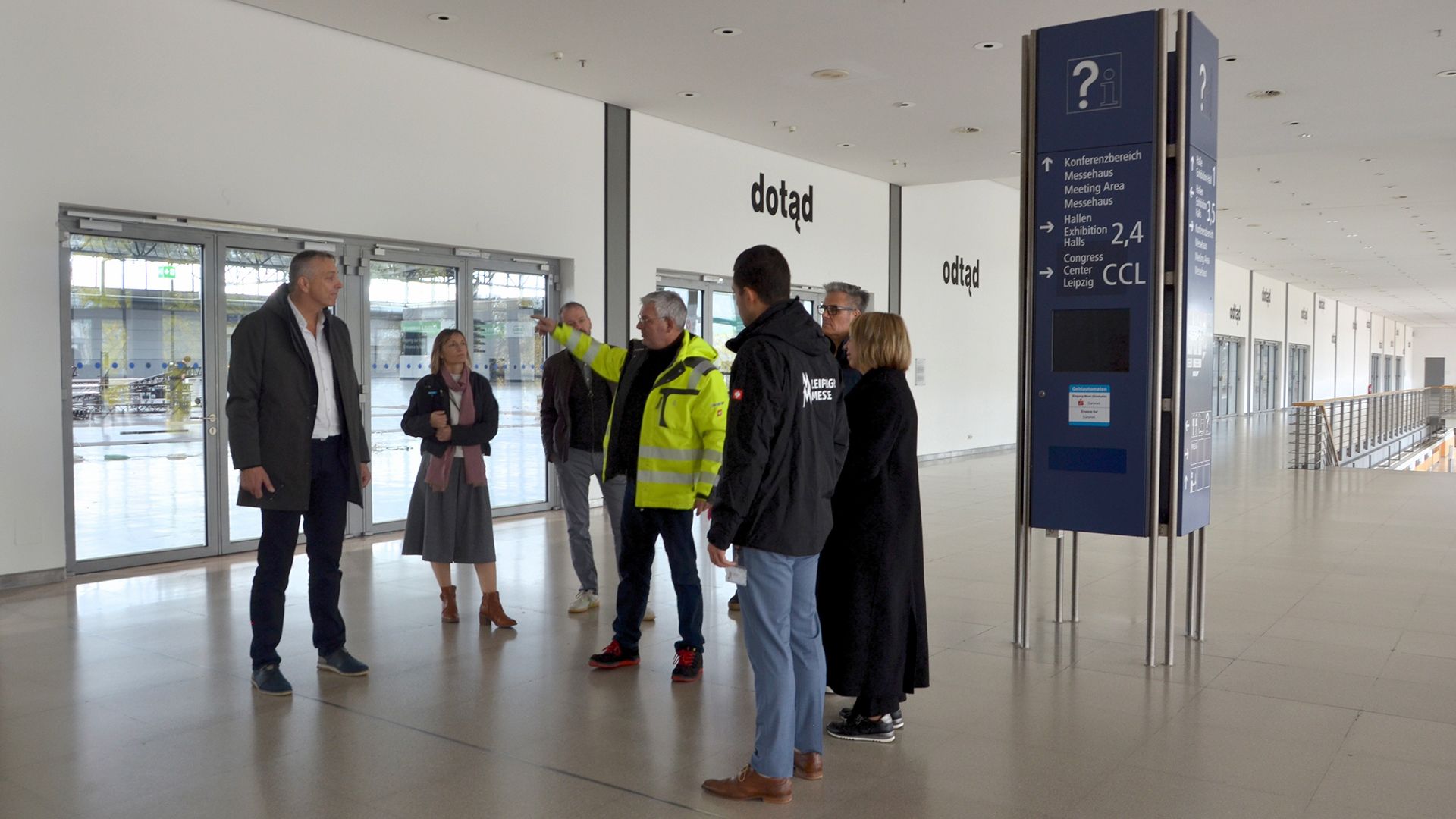
At the end of October 2025, the KRIDEM project team met at the Leipzig Trade Fair. Photo: tw tagungswirtschaft / m+a report
“The KRIDEM project is truly doing pioneering work,” says Barbara-Maria Lüder, Sustainability Manager at AUMA – the Association of the German Trade Fair Industry. “For the first time, the circular economy within the trade fair industry is being examined in a scientifically robust and practical way. The insights gained will benefit not just Leipziger Messe, but the entire industry in building sustainable structures and advancing targeted transformation processes.” With the selection of OTWorld and the initial on-site meeting in Leipzig, the project has already established a solid foundation. The next step will be the systematic collection and analysis of material flows, data, and organisational structures."
At the end of May 2026, OTWorld will provide a live showcase of how the circular economy can be measured in practice at a trade fair—and what practical recommendations for action can be developed as a result.