Interview with Maritta Lepp
"Leadership becomes smarter"
Photo: Munich Trade Fair
Photo: Munich Trade Fair
Maritta Lepp is project manager for Ceramitec at Messe München. In this interview, she explains how smart job sharing paved her way back into management after parental leave, why clear lines in the tandem model often create more freedom – and why it is worthwhile to confidently exploit your own professional creativity.
m+a report: In the portrait film by Messe München, you are a visible example of female leadership. What kind of response do you get from the workforce?
Maritta Lepp: I have actually received quite a lot of feedback – very different responses. It ranges from "It's great how you manage to do it all" to "Thank you for giving us an insight. Your example is encouraging." I am particularly touched not only by the reactions of my young colleagues, although it is of course nice to be able to inspire them a little. I also find the feedback from experienced colleagues who say, "Hey, cool, keep it up," very valuable." I find that really encouraging and appreciative, because they may have a different understanding of what it means when things change and it's not always just the same old roles and paths that are followed. And if my path serves as an alternative or guidance for others, or can give them confidence, then of course I'm very happy about that.
After your parental leave, you initially entered into a tandem model. How did you structure this model in concrete terms – for example, in terms of task distribution, handover and decision-making rights?
We were supported in this tandem model by People & Culture. We were advised to think carefully about how we wanted to structure it, and we had a coach at our side who we could turn to with any questions. My tandem partner and I then made a conscious decision against the seemingly usual model, in which everyone does everything. From an industry perspective, this made little sense to us. It was clear to us that a clear division of tasks was more important. We therefore divided it up so that my colleague took over the "Foreign Office", focusing on customers, marketing and sales. She was the public face of the company. This was also due to the fact that I joined the company at very short notice before the upcoming trade fair and we wanted consistency for our customers in terms of contact persons. I was responsible for the "interior ministry" with the internal interfaces, the cross-departmental divisions, including human resources management. It was important to us to reduce complexity – for the team, but also for our customers – and to work as efficiently as possible. I had already managed trade fairs in Germany and was therefore able to use my existing good connections with the internal interfaces. When two people only work 20 hours a week each, efficiency is crucial. You can't spend half your working time on coordination. That's why we basically had two clear rules: decisions within our own areas of responsibility were not questioned by the other, and we developed strategic issues together. In addition, we exchanged ideas as the situation demanded – in the office, via Teams or sometimes by voice message in the afternoon between childcare appointments. And that worked very well.
You said you rejoined relatively shortly before Inhorgenta. How tight was the timeframe?
I returned six weeks before the trade fair. This allowed me to take on the entire internal coordination effort. I knew what was important and who the contact persons were. I think this was a very good division of labour for my tandem partner and me.
With a new focus, a high level of international exhibitor participation and a focus on future topics, Ceramitec will open its doors at the Munich Exhibition Centre from 24 to 26 March 2026. The exhibition covers the entire spectrum of ceramic materials: from classic ceramics and refractory technology to high-performance ceramics.
Photo: Munich Trade Fair
And what is your colleague doing today?
We both benefited from the tandem model. My colleague had previously handled the entire job as a project manager on her own, working part-time. Now she is on parental leave after having her second child. For me, the model was also a stroke of luck because I was able to increase my hours step by step and eventually return to full-time work.
From today's perspective, what would you perhaps do differently in this model?
I would do it again exactly the same way. The division of responsibilities was exactly right for the situation at the time. Today, with the experience I have gained and my role as the sole project manager, I would probably tailor the tasks differently – for example, with a stronger external presence. Under the conditions at the time, the clear, separate distribution of tasks made perfect sense. And I would still say today that a clear division of responsibilities is important – not everyone does everything.
In Germany, almost half of mothers working part-time would increase their working hours if conditions such as flexibility, communication and career prospects were improved. What factors were decisive for you in returning to full-time work?
After about six months, I increased my hours to 30 and three months later to 40. The decisive factor was that the company gave me the opportunity to increase my hours. And to be honest, it was my plan from the outset to return to full-time work as soon as the opportunity arose. I was initially concerned that I would not be able to keep my position as project manager while working part-time. So I was pleasantly surprised when People & Culture brought up the possibility of job sharing during our conversation. This showed me how important it is to actively approach your employer instead of thinking from the outset, "It won't work anyway." Together, we can often find good solutions – as in my case with the tandem model. And I have learned that at Messe München, increasing or reducing hours is not an issue. You just have to talk about it.

"It's better to be brave and put in more hours – the work will get done anyway."
The second factor that concerns many women or mothers is the issue of finances. I realised early on that if you officially work 20 hours, your workload does not automatically reduce by the same amount. Be honest – how many hours end up in your flexitime or overtime account? That's why it was clear to me: it's better to be brave and work more hours. You'll be working those hours anyway, but I don't want to miss out on the salary and I'm also doing something for my pension in the long term. I always tell my colleagues: if you're worried about whether you can manage five more hours, take a look at your flexitime account. Work out how much you actually work. Do you really work 20 hours – or is it more like 25 or 30? Then you might as well take the money.
What makes Messe München a family-friendly employer for you?
For me, there is a "soft" factor – I'm not quite sure how to describe it. It's something you just feel: that children are welcome. And not out of a sense of duty, because it's written down somewhere on paper, but out of genuine appreciation. This is evident, for example, at summer parties where children are allowed to come along, in the home office when they walk through the picture, or during the holidays when they come to the office. Whether it's direct colleagues, other employees or in the canteen – people smile and are happy. This feeling that family is not a nuisance but part of the team is a great emotional support for me. And I need that in my everyday life.
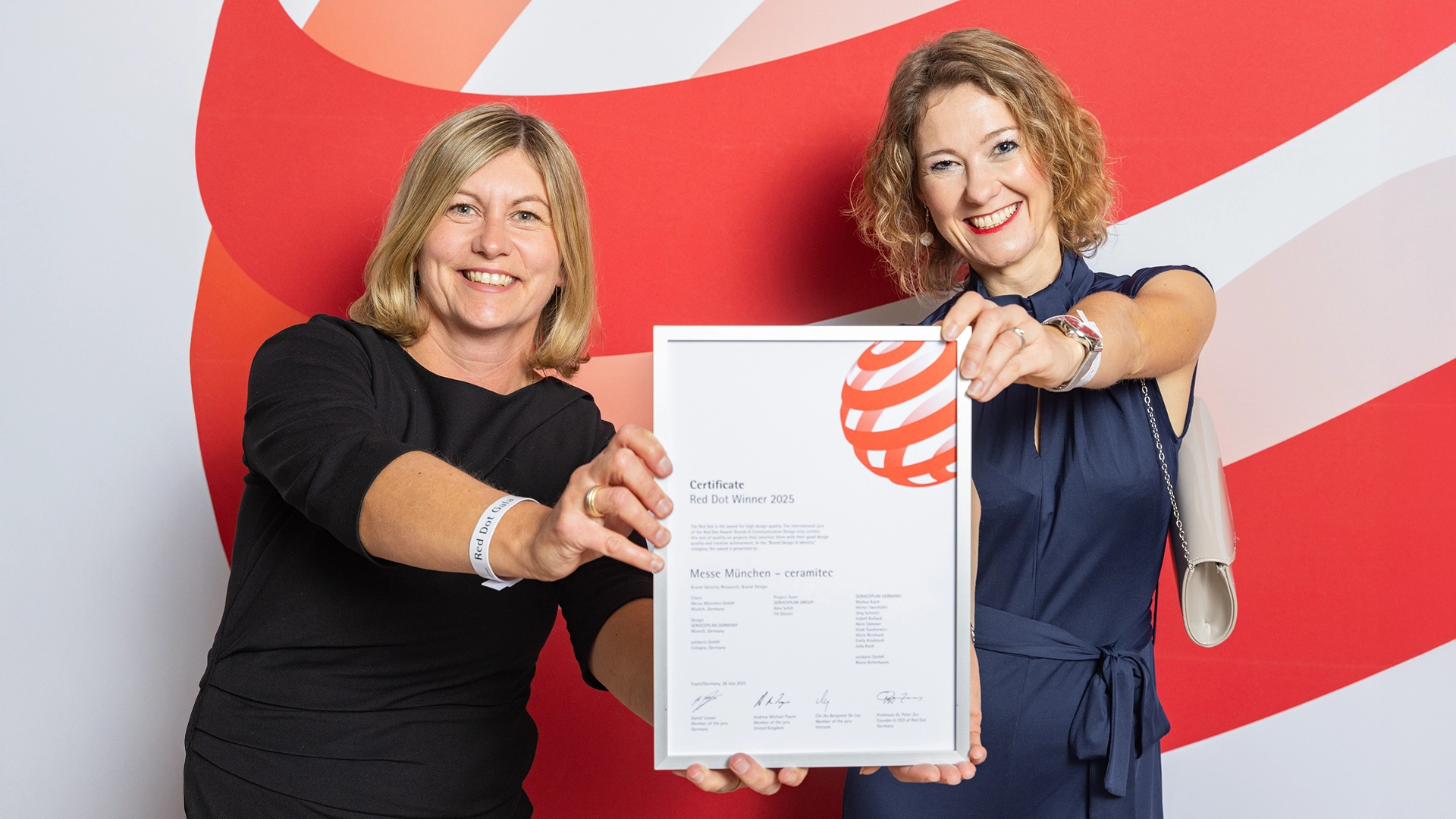
Messe München received a Red Dot Award this year for Ceramitec's brand strategy, which was redesigned in 2024. From left: Tanja Schneider, Brand Manager, and Maritta Lepp, Exhibition Director of Ceramitec. Photo: Messe München
And then, of course, there are the "hard" factors: the opportunities that Messe München creates to enable people to balance family and career. Flexible working hours, up to 60 per cent mobile working, workation opportunities, and in my case, the opportunity to return to work through job sharing. In addition, there is parent coaching, which provides tips and guidance – or simply helps you to find your inner balance again. Exchange with other parents is also encouraged. These structural conditions are essential. And I really appreciate that Messe München makes all this possible. Not everything has to be perfect at work – but it is crucial that you can find solutions together that fit your own life.
How does work-life balance also change leadership culture? Is leadership becoming softer, more empathetic, perhaps even more collaborative today?
I am firmly convinced that work-life balance, or rather the demands of combining family and career, has changed the culture of leadership. And I very much hope that this change is here to stay. For me, this does not necessarily make leadership softer, but it does make it more intelligent. For me, intelligent leadership means deciding on a case-by-case basis when to share responsibility, when to give room for development, and when to lead more individually by taking into account the respective life models of employees. In the trade fair context – at least at my employer – this is very consciously practised. We focus on transformational leadership, i.e. leadership through motivation, trust and joint development. And I notice this very clearly in my everyday life: when I talk to colleagues who want to balance family and career – whether because of children or caring for relatives – it becomes clear how important it is as a manager not only to create structures, but also to show attitude. You have to really mean it and live by the principle that work-life balance is important. This includes listening carefully to employees: What is their current situation? What challenges or needs do they have? And then you have to be prepared to relinquish some control and say, "I trust you to manage your time and your tasks responsibly if I give you the freedom to do so." This not only changes the management culture – it also changes the way we work together. And yes, it creates a more empathetic and human level of interaction.
Has your own management style changed since you became a mother?
Yes, I would say that my leadership style has changed – not in terms of my core values, but in the clarity with which I represent them. I have noticed that I am now much more confident and resolute, especially when it comes to balancing family and career. I used to often worry about what others might think of my decisions. Today, I tend to ask myself: Is it right for me? Is it right for my family? Is it right for my job? And if so, then I just do it. Surprisingly, it works, and no one questions it. That's a lesson I'm happy to pass on: Stop worrying so much. In most cases, the way you organise your work is perfectly fine.
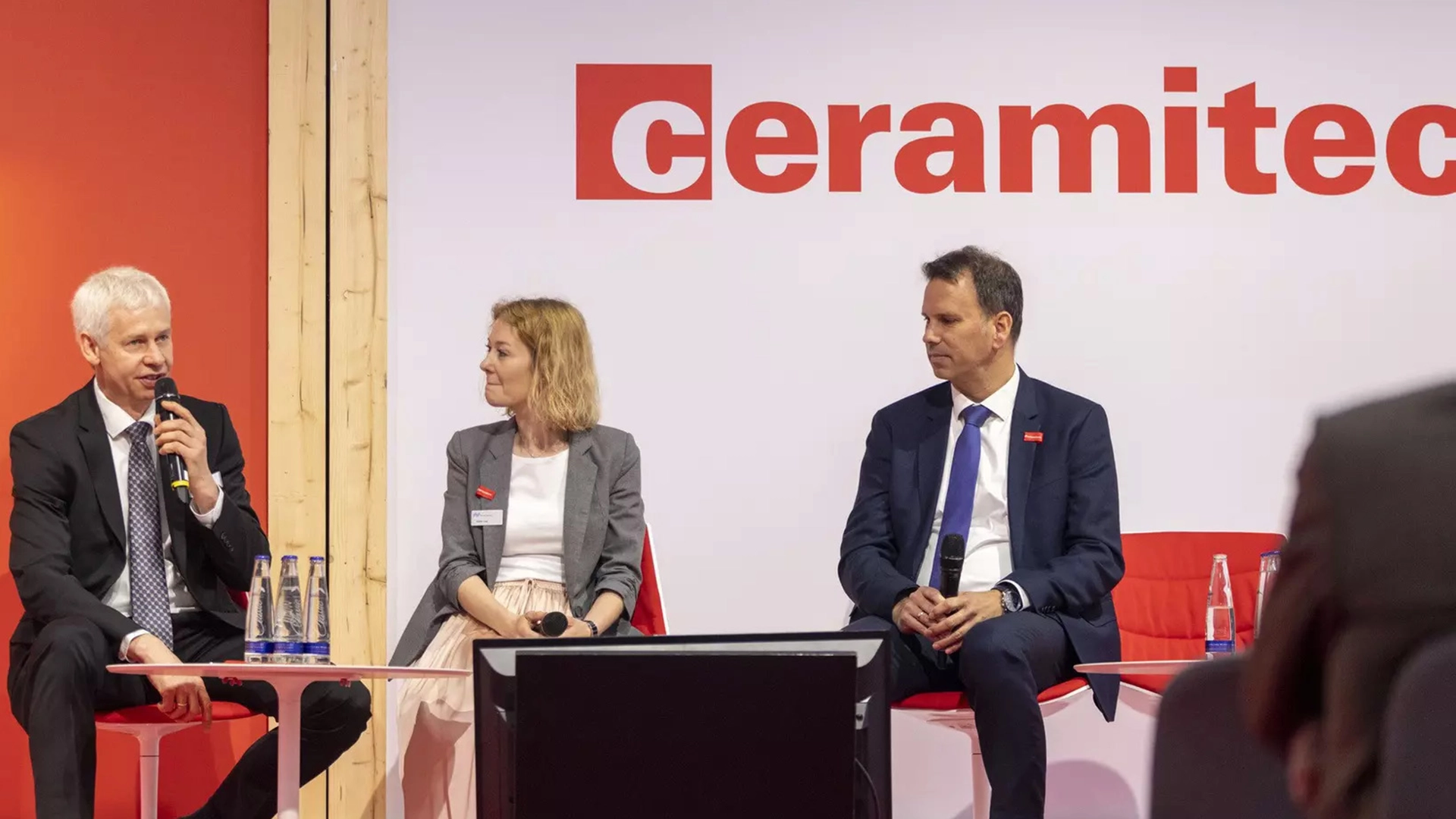
Maritta Lepp (centre) at the Ceramitec Talks 2024. Photo: Messe München
I have also become more impatient. When you want to balance children and a career, time is a precious commodity. I am more sensitive to time wasters. If someone comes to a meeting unprepared, I address it directly. It helps me maintain balance. Empathy has always been important to me. But today, I know from my own experience how crucial it is that colleagues with family commitments are given the necessary freedom. Not only do I now know how important this is, I also try to live it more consciously and set an example.
Your husband also works at Messe München in a management position and speaks openly about being just as involved in care work as you are. How do you manage this partnership-based division of labour in everyday life?
From the outset, we agreed that despite our full-time jobs, we didn't want to put our daughter in full-time childcare, but wanted to look after her ourselves. Thanks to the option of working remotely up to 60 per cent of the time, we can look after her at home after nursery from midday onwards. In practice, this means that we schedule our appointments so that as much as possible can take place in the morning. If there are afternoon appointments, we take turns – one of us attends the appointment, while the other has free time to look after our daughter. And yes, sometimes that means we have to work again in the evening to catch up on emails. That's what our normal working week looks like. During trade fairs, one of us covers for the other and takes over childcare completely. But that works too, because these phases are predictable, the conditions are right, and our employer trusts us to do our jobs and that it's the result that counts in the end – not the time it takes to achieve it. Of course, it takes a lot of coordination, but it's doable.
Keyword: predictability. In the events industry in particular, there are phases with a lot of travel and a heavy project workload. How do you manage to plan for yourself and your family during these peak periods?
The positive thing about the events industry – at least in the trade fair sector, I can't speak for concert organisers – is that our profession offers a high degree of predictability. Trade fair dates, conferences and many other formats are usually fixed at least six months in advance. Customer visits can also be organised with sufficient lead time. And anyone who has ever been through a complete trade fair cycle knows exactly when the workload increases and when things calm down again.
Photo: Munich Trade Fair
This predictability helps enormously. At the beginning of the year, I make an overview of the most important business trips and appointments and enter everything in our family calendar. During these times – and especially in the last few weeks before a trade fair – my husband supports me and takes care of the children. The same applies vice versa. And in the rare cases where appointments do overlap, we have enough lead time to organise support, for example from the grandparents. That's why, to be honest, I don't find it that difficult to balance family and career despite travelling. It takes some organisational effort, yes – but we are used to planning, organising and improvising to the same extent, both professionally and privately. Otherwise, we would be in the wrong profession. And that's exactly what plays into our hands.
What are your hopes for the next generation of parents in leadership positions?
I would like them to stop asking themselves whether career and family are compatible – because it has become a matter of course. I also hope that they will have more confidence in themselves and not let old role models unsettle them. Leadership is also possible with a family. And above all, family is also possible with the responsibility of one – or even two – leadership positions. This is often called into question: in the company, whether family and career are compatible. And in the private sphere, conversely, whether one can do justice to one's family when taking on a leadership position. My tip: don't let yourself be unsettled.
"The key is to be able to find solutions together that fit your own life."
I would like companies to recognise how valuable parents in management positions can be – and to support them when necessary. This is what happens at Messe München: through coaching, mentoring or a family-friendly management culture. And last but not least, I hope that for future generations of parents, neither gender nor age nor a possible future family situation will play a role in filling positions, but only competence and suitability for the job.
What advice would you give to young women who aspire to leadership roles and want to start a family at the same time? And perhaps also to the bosses of these young women?
When young women want to pursue a career and start a family at the same time, the most important thing they need to do is talk to their partner in good time. They need to be open about the fact that they don't want to put their career on the back burner and discuss how they envisage sharing the care work. After all, it takes two to make a family – and it's not right that one parent should have to give something up if they don't want to. Young women shouldn't be satisfied with the phrase: "Somehow we'll manage." This discussion must be had at the beginning so that women do not end up in a weaker position, taking a back seat and falling back into "traditional roles". Because if the majority of family responsibilities automatically fall to the woman because nothing was clarified beforehand, she will later lack the time and energy to further her career. Communication is everything here – you can only do it together. I have filled positions myself. As a manager, you are responsible for business decisions – and that naturally includes assessing development potential and possible absences. That plays a role, there's no denying it. But I strongly advocate not rushing to judge an employee who signals that she aspires to both a leadership role and a family as a risk. The question should rather be: Does this person really stand behind her decision? Does she have the motivation, resilience and sense of responsibility to juggle a career and children? My appeal is this: trust your knowledge of human nature. If you believe in someone, then give them the opportunity. In the vast majority of cases, this trust pays off – both personally and professionally. Because a woman (or a man) who says, "I want to try both – a career and a family" and is given the necessary framework to do so will repay the company with motivation, performance and a healthy dose of responsibility.