Interview with Claire Steinbrück
„All eyes on all“
Photo: Andreas Wiese
Photo: Andreas Wiese
Claire Steinbrück is Head of the Global Corporate Development and Strategy division and has been a member of the Management Board of Messe Düsseldorf since July 2025. In this interview, she talks about the appeal of an industry-focused event portfolio, the importance of internationalisation, diverse leadership cultures and what she currently considers to be the most important issues in the trade fair industry.
m+a report: Since 1 July 2025, you have been Head of the newly created "Global Corporate Development and Strategy" division at Messe Düsseldorf. How have you found your first few weeks in your new role?
Claire Steinbrück: This is a very dynamic and exciting time for me. I have been given a very open and warm welcome – in a remarkably human way. I noticed that immediately. People always say: a trade fair is a trade fair. But in the end, every trade fair is different, and that is very clear here in Düsseldorf.
How do you see this difference manifesting itself, for example?
For one thing, the portfolio here is completely different. In Frankfurt and Cologne, I didn't work with such a heavily industry-focused portfolio. I find that exciting because I believe that an industry portfolio has different expectations of a trade fair than a consumer goods-oriented one. And then there's the culture: that's also very unique here. For example, I can really identify with the internal motto "Show your best". This interplay of portfolio, mentality and attitude creates a unique personality. And you can really feel it.
Which topics are you particularly focused on in your new role?
My top priority is the strategic development and safeguarding of the global portfolio. In addition, there is a strong focus on exploring new topics and new formats. Another key point is the further development of our internationalisation strategy. In my view, these are the main pillars.
Your area of responsibility includes tasks such as new product development, market research, partner and guest events, and international business. Where do you see the greatest opportunities for Messe Düsseldorf?
There is enormous potential in all these areas. We have a highly profitable portfolio that we need to develop further, both locally and globally. At the same time, the trade fair industry is undergoing a phase of intense transformation: new topics, new markets and new needs are emerging. And this is precisely where we see great opportunities that we are focusing our attention on. Focusing on just one area would mean ignoring other important topics, and that would be problematic in my view. For me, therefore, the motto is: all eyes on all. This applies both to our portfolio in Düsseldorf and to our internationalisation strategy. Geopolitical developments are changing markets, regions and behaviour patterns. As a result, local platforms and regionalisation are becoming much more important than they were a few years ago – which in turn brings new challenges for leading trade fairs.
Messe Düsseldorf has continuously expanded its international portfolio in recent years. Which regions or markets are you particularly focusing on?
It's no secret that many trade fair companies are currently looking very closely at the Arabian Peninsula. Saudi Arabia and the UAE with Dubai are extremely exciting and rapidly growing markets. Then there is India, with its enormous growth potential and huge economy. But it is just as important to me not only to ask where we are going next, but also where we are already represented – and to continuously question and rethink these commitments. That is why we are examining very closely: In which countries are we present and how? What events do we have there? And how do we need to develop them further?
Let's go back a little in your career: most recently, as Head of Trade Fair Management, you were responsible for the strategic and conceptual management of Koelnmesse's global food technology trade fair portfolio. What experiences from this time are particularly valuable to you today?
I am a total team player and had a strong team that was always willing to stand up for each other and go the extra mile. That was a huge privilege, and I have another great team here. Equally important were strong partnerships and clear solidarity with everyone involved. What has also shaped me are my international experiences from many stays abroad. This exchange – whether in large or small projects – and the openness to learn from each other are still crucial for me today. These are my most important lessons from that time.

"It wasn't a decision against Cologne, but a clear decision in favour of Düsseldorf."
It was an important chapter with many special people, and it was difficult for me to let go of my team. But letting go also means starting something new. Here in Düsseldorf, I have the opportunity to shape a completely new area – I find that extremely exciting. I previously worked for Messe Frankfurt in various countries for 13 years and was then responsible for the outbound business in Cologne and later for the internationalisation of the food technology portfolio. Here, I can continue to pursue these topics on a whole new level. For me, this is a truly responsible and enriching task. So it wasn't a decision against Cologne, but a clear decision in favour of Düsseldorf. A big step, both professionally and personally.
What lessons have you learned during your time as director of Imm Cologne and on various international projects at Koelnmesse, as well as during your time at Messe Frankfurt – with assignments in Mexico, Argentina and Italy, as well as Deputy Director of the German Pavilion at Expo Milano 2015 – for your management and strategy work?
I believe that leadership is first and foremost about your own personality. Over the years, I have had the opportunity to observe many different leaders. I have learned a lot from this: things that I found particularly admirable and others that I now consciously want to do differently.
Messe Frankfurt was commissioned by the Federal Ministry for Economic Affairs and Energy to organise and operate the German Pavilion with the motto "Fields of Ideas" at Expo 2015 in Milan. Photo: keller-fotografie.de
In the end, it all comes together: your own personality and attitude, the experiences you have gained, and what is important to you in your interactions with others – or what you would do differently. And there is a special openness that comes from not only having been in one location and in a single role, but from having worked with different cultures and teams. This ultimately results in your own signature: how you lead and how you define strategy. It's probably a kind of formula made up of experience, personality and a certain leadership ability.
Were there any obstacles on your path to top management and, if so, what helped you overcome them?
Surely everyone faces challenges at some point. Personally, however, I have never experienced any real barriers that would have slowed me down. In my case, there have always been people in my life – sometimes by chance, sometimes because they were my direct superiors – who clearly recognised me as a mentee and told me, "You're going to take this step now." They encouraged me and helped me to develop courage, dynamism and self-confidence. Or they told me honestly: "You can't move directly into this field right now, take another step first so that what you are planning really makes sense." That was also valuable. My parents' home also had a big influence on me. We moved frequently. For me and my siblings, this newness was never something to shy away from, but something to embrace. We grew up bilingual in a German-Belgian environment. That creates a certain openness at an early age. And this confidence to simply try things out has stayed with me to this day. But of course there are barriers – or issues that still have an impact. I wouldn't necessarily call it a personal barrier, but I have often encountered situations where women are denied recognition for their achievements or competence because they are reduced to their gender. People say things like, "Well, of course, it had to be a woman." No one would question that if it were a man. That's not fair to women. Ultimately, the best person should get the promotion – based on their qualifications, experience and because they have the right skills.
You have just described how important it is to believe in yourself. What role does visibility play in this?
Sometimes you need that invisible hand behind you – it doesn't grab you or carry you, but it's there. And luckily, I had such invisible hands, so I knew that I could only fall softly. Because you need that hand especially when you take a step that you're not entirely sure about. And that brings us to the topic of visibility. Sometimes you have to come out of hiding, show yourself and clearly signal that you are ready to take on responsibility. And once you've taken that step, you're in a different circle. And there, too, you have to make yourself visible again, say something, speak up. Dare to do it. As a young woman, I went to Mexico City for six months. Many would probably say: too dangerous. But I had this experience, with all its good and difficult moments. And it shaped me. When someone says today, "She's taking over the international business of Messe Düsseldorf" – I do so authentically, partly because I have lived abroad myself and because I believe in myself. If I had never come out of hiding, we might not have anything to talk about today.
Speaking of experiences: networks often help with exchange and career development. Have you benefited from such networks or been supported by them?
I once took part in a mentoring programme that focused on the topic of visibility. I fundamentally believe that networking is important and that exchange always helps. Networks like this can definitely be beneficial. I found a networking meeting that was co-initiated by colleagues from Düsseldorf Congress particularly exciting. Different networks came together, and that's exactly what I found enriching.
The Female Network Festival
The Female Network Festival is, according to its own information, the largest women's networking event in Düsseldorf, initiated by Düsseldorf Congress, Rheinbahn, Stadtsparkasse Düsseldorf and Stadtwerke Düsseldorf. The format brings together executives, founders, young talents and experts. The focus is on keynotes, workshops and mentoring opportunities on topics such as career development, leadership, visibility and diversity — with the aim of connecting women, promoting dialogue about opportunities and challenges, and providing impetus for professional and personal development. The next edition will take place on 3 March 2026 at the CCD Congress Centre Düsseldorf.
When we talk about diversity, for me it's about genuine mixing. Many networks naturally have their own focus – that's valuable because you can share experiences and strengthen each other. But if we really want to understand where the barriers lie, then we need openness on all sides: Where are we stuck? What is holding us back? To be honest, I find such changes in perspective the most exciting. They allow us to draw conclusions about what structures might actually lead to greater diversity – and also to more women in leadership positions.
With you and Petra Cullmann, there are now two women at executive director level at Messe Düsseldorf. This also makes you one of the few women in the management of a large German trade fair company. What do you think: does this have any significance for the work in the committees and for decisions and priorities?
What I do believe is that in groups consisting solely of men, certain aspects are viewed differently or perhaps less broadly. That wasn't the case here before, because Petra Cullmann was already at the table, but with two women in the group, different perspectives are certainly added. And in my opinion, this broader perspective also produces a different output. When you look at challenges or decisions from multiple angles, different ways of approaching them emerge. I believe that this can only add value – at least, I hope so.
And when we talk about different perspectives, what role does the leadership culture play in how leadership – including female leadership – can develop?
I believe that the decisive factor here is not so much gender as the opportunity to express one's own leadership style. This has a lot to do with leadership culture and the characteristics of a superior or management team. The question is: Can I be myself? Can I approach things in a way that suits me? I would attribute it more to women to bring in stronger emotional or interpersonal aspects. We shouldn't train ourselves out of this, because it is precisely these differences that make up diversity. The key is that this diversity is allowed, lived and appreciated. Different personalities and focuses often lead to better results when combined.
You are also a mother. What conditions do managers with care responsibilities need in order to make international roles realistically feasible?
I have two children, twin boys who are two and a half – very challenging, but wonderful. What do we need? Much of it has to do with what we've already talked about: daring to do things. I often feel that many women think very much in terms of if-then models. What if I have children? What if ...? These scenarios are often rather negative. And then they don't dare, they don't raise their hands, they stay where they are – out of fear of something that no one knows will even happen. But: if I want to have children, I can take that step – and still do my job. I hope that I might even set an example in this regard. I have always done my jobs with passion, and I believe that when we do what we love, it has a positive effect on our family life. This idea that "if you have children, you can't have a career..." – we women need to get rid of that.
"Sometimes you need that invisible hand behind you."
The second level concerns our system in Germany, where employers can do little to compensate. I think the structural framework conditions are a disaster. I returned to work full-time after ten months and had no clear childcare arrangements. Without shared parental leave, we would never have managed it. And yet, the emotional stress of the nursery cancelling at short notice in the morning and having to organise childcare at the last minute before your first meeting – that is an infrastructural task for the state. Only when childcare is reliable will women and men feel motivated to say, "We can do this." And the third point concerns companies. This brings us back to the topic of leadership culture. In no conversation here at Messe Düsseldorf did anyone ever ask, "But you have children – how is that going to work?" It was never relevant that I am a woman or a mother. For me, that is true equality. I come as a high performer – the company sees that and makes its decisions accordingly. The fact that I am also a mother is still part of who I am. It is important that children can be taken into account in everyday working life. When my children are ill, I stay at home and still work. Then I take a feverish child in my arms during a break because it is important to me. That has to be normal. And then there are also very practical factors. Messe Düsseldorf has a company crèche – an enormous factor for the female managers of tomorrow.
When we think of peak periods at trade fairs, what do you think a family-friendly "peak operation" might look like and how could it be implemented across the group?
When you choose to work in the trade fair industry, you also choose to experience these peaks – and many of us love them. One of my favourite phases is the time just before a trade fair, when the excitement builds and the final preparations are underway. Telling someone, "You're staying at home now or working from home for two more days" – many people here wouldn't want that at all. That's exactly what drives us and what we're all about. But what works in our favour is that we know early on when the trade fairs are taking place, when intensive phases are coming up or when longer trips are planned. This allows us to organise a lot in advance – and that makes the industry more family-friendly than you might think.
What measures do you generally consider helpful in bringing more women into leadership positions in the trade fair industry?
I believe that it is primarily up to us to say, "I'm going to take this step." Networks, mentoring programmes and various meeting places can help – there's no question about that – but ultimately, we women have to take this step ourselves. My impression is that a lot is happening: there aren't many of us yet, but we are becoming more visible. And visibility creates role models. At the same time, there will be a huge change in the German trade fair industry in the coming years. Many baby boomers in management are retiring. This means that positions will become available, and hopefully it is only a matter of time before more women move up. What we need for this is courage – especially for women in the second and third rows. The real movement must come from within ourselves. That's why I don't believe in a magic formula where every company has to tick off certain measures. It's a change – and that change has long since begun.
What opportunities do you see for Messe Düsseldorf to position itself in international competition, perhaps also through a more diverse management culture?
I see two points here. On the one hand, different perspectives in terms of diversity produce different outputs. When we examine challenges or tasks from different perspectives and tackle them with different approaches, this automatically leads to a broader and deeper engagement with a topic. This often leads to better results, simply because more facets are taken into account.
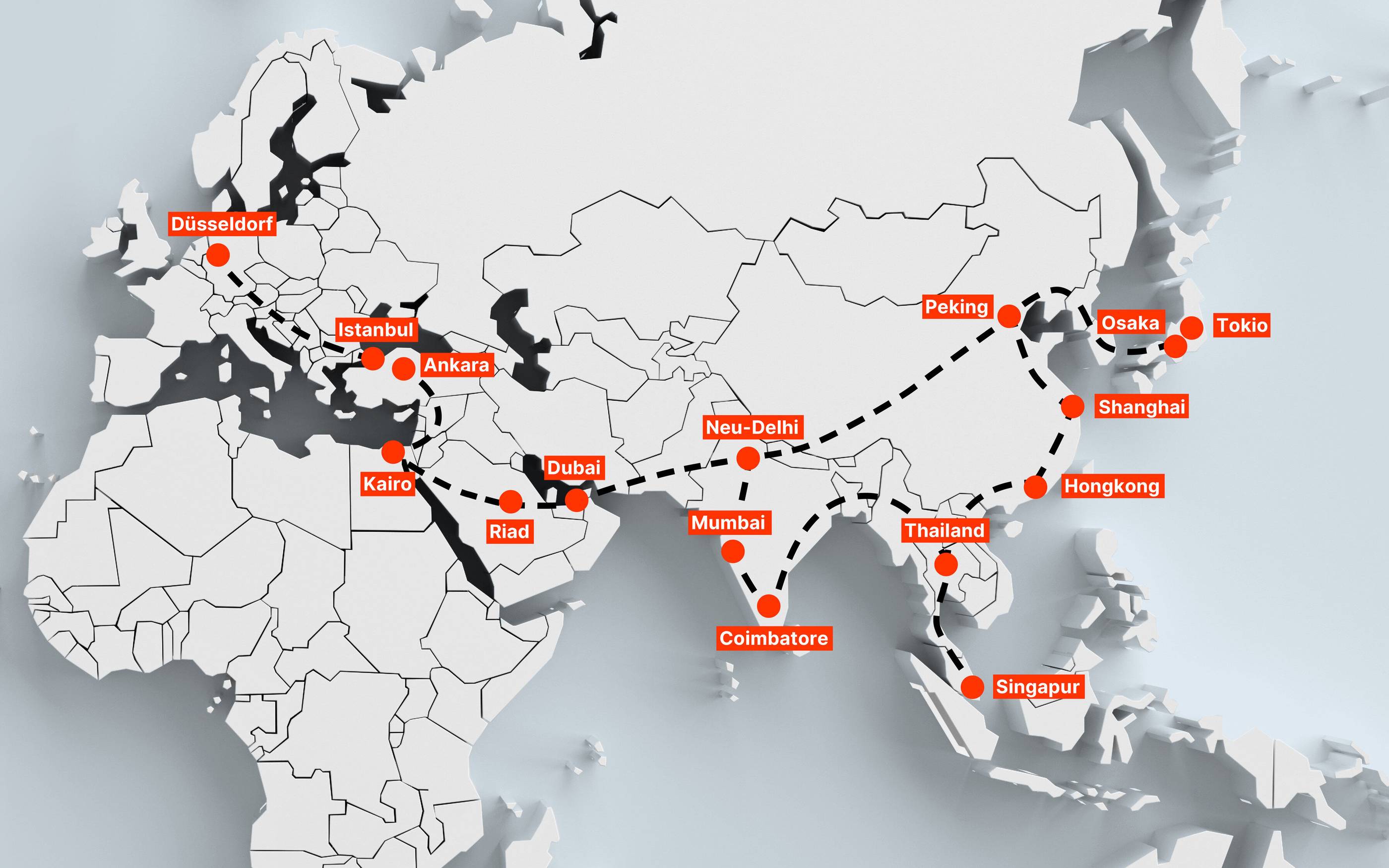
Map showing the locations and investments of Messe Düsseldorf in Europe, Africa and Asia. Graphic: Messe Düsseldorf
On the other hand, an authentically diverse management team has a strong external impact. This fits in very well with "Show your best". We want to appeal to the best minds – the trade fair organisers of tomorrow. And a diverse management team sends a clear signal: We stand for diversity, we are broadly positioned, and we do not represent a purely male or female team, but a company that brings together different people and perspectives. This is important for our positioning in international competition. It shows what Messe Düsseldorf stands for, conveys a set of values to the outside world and hopefully appeals to the talents we want to attract for the future.
What advice would you give to those aspiring to a career in the trade fair industry?
You should remain curious and be prepared to leave your comfort zone. For me, courage and openness are key qualities for a career in the trade fair world. And optimism. For me, the glass is always half full – this attitude helps you to rethink things and break new ground. I have been organising trade fairs for many years. For me, it's one of the best things you can do: bringing people together. Despite all the digitalisation, AI and everything else that is yet to come – and that is also diversity, everything has its place – we must continue to create platforms where people can meet in the future. And for that, we need people who want to think ahead and design these concepts and platforms – people who are enthusiastic about exchange, the future and diversity.